I am a data scientist passionate about applying AI to build scalable and impactful solutions. I have experience in supervised, unsupervised, and reinforcement learning, working with Python, PyTorch, TensorFlow, and Hugging Face on CV and NLP projects. I also work with SQL, distributed processing, and AWS/Azure, focusing on production-ready ML pipelines and business impact. My commitment to continuous learning constantly drives me to broaden my horizons of expertise.
🎓 Education 🎓
-
Ph.D., Computer Science Computing Research Center (Jun 2027) -
M.S., Computer Engineering Computing Research Center (Jun 2023) -
B.S., Control Engineering National Polytechnic Institute (Dec 2020)
Work Experience
Data Scientist @ BBVA México (_Apr 2025 - Currently)
- End-to-end development of data science solutions focused on credit default prediction, from understanding business needs to supporting production deployment. I collaborate with multidisciplinary teams across different geographies to design and implement regulation-compliant analytical solutions. This includes model scoring monitoring, performance tracking, and continuous improvement, leveraging AWS services such as EMR and SageMaker to ensure scalability, reliability, and operational efficiency.
Data Scientist @ Bluetab Solutions México (_Jan 2024 - Apr 2025)
- I am the technical lead of a team at Bluetab, where I am responsible for addressing their questions and overseeing their activities. As a consultant, I have conducted statistical tests for the estimation of credit risk models, applied regularization methods to mitigate their deficiencies, and used tools for data analysis and processing. I have also generated documentation in compliance with regulations and developed dashboards to display the capital impact estimates derived from the implemented risk models.
Classroom Lecturer @ FEMEX (Dec 2022 - Jan 2023)
- Demonstration of the Habitat AI simulator via python framework. A demonstration of reinforcement learning models (PPO) as well as classical models (SLAM) within the simulator was presented with Python.
💡Projects
🍅 Image Segmentation for greenhouse 🍅 (2023-2024)
A series of state-of-the-art models — including Segformer, MaskFormer, Mask2Former, YOLOv11, and UNet — were implemented and fine-tuned for image segmentation in greenhouses. This project, covering everything from data collection (with a custom-built dataset) to deployment in Hugging Face Spaces, provided a comparative evaluation of each model’s performance in agricultural environments.
The approach utilized Hugging Face tools (Pipelines, Datasets, AutoTrain), along with PyTorch, Segments.ai, and Gradio, ensuring an end-to-end solution tailored to assess and deploy these models for agricultural applications.

🌽 Autonomous Navigation Vision System 🌽 (2023)
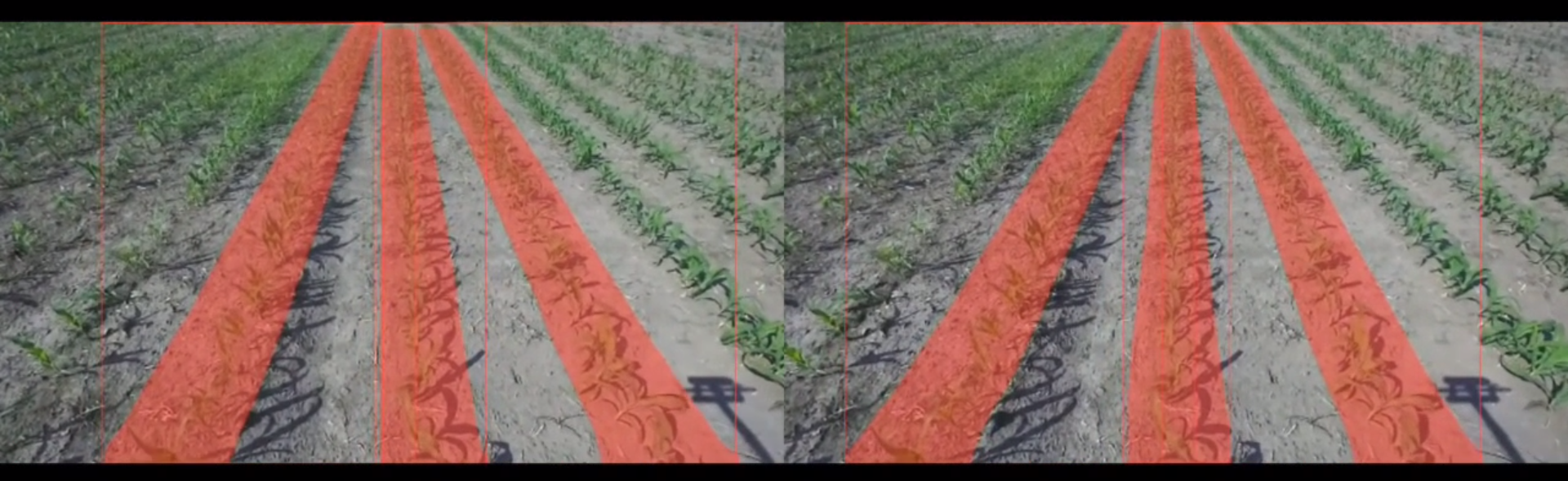
An autonomous navigation system was developed for agricultural robots based on the tracking of corn rows through image segmentation with deep learning models. The system was implemented on Jetson Xavier and Arduino devices. Languages and frameworks such as Python, Pytorch and Tensorflow were used.
❗ Risk Classification ❗ (2024)
This project intends to evaluate the risk of individuals as Good, Medium and Bad according to variables such as age, income, number of children, credit cards, mortgage among others for decision making. Cleaning and preprocessing tasks, outlier detection as well as modeling (AdaBoost) for the classification task were performed. Libraries such as Pandas, Plotly, Scikit-Learn and NumPy were used.

🍄 Fungi imaging with diffusion models 🍄 (2023)
This project aims at the unconditional generation of fungal images using a DDPM (Denoising Diffusion Probabilistic Models) model with a UNET architecture, with an image size of 128x128 pixels. The dataset used was extracted from Kaggle and two different approaches were explored: a model trained with the whole dataset and another trained only with two specific classes of fungi.
Libraries and tools:
- HuggingFace
- Datasets
- Kaggle CLI
- Pytorch
- Accelerate
- Wandb
🐄 Analysis of Milk Quality 🐄 (2023)
Classification of milk quality based on a dataset obtained from observations at milking. Interesting dimensional reduction techniques were applied as well as the deployment of the classifier in Flask, also Scikit-learn tools were used.

Further training
I am a person who is constantly learning, that is why I like to attend workshops, conferences or take online courses on professional topics or hobbies.